Twenty-five years after September 11, the struggle over who belongs at its memorial reveals how much of its human cost we still refuse to recognize.
Whoosh, whoosh, whoosh.
Underneath that—or inside it, because in my memory all the sounds have become almost impossible to separate.
Oh my God! Oh my God!
Should the kids be seeing this?! Should the kids be seeing this?!
And then the beginnings of sentences that twenty-five years later, are still without endings.
My husband…
My mommy works there… Is my mommy okay…
I was in middle school in Yonkers, New York, at what was then Museum Middle School, in the building that now houses Riverside High School. It sat right on the Hudson River, with a view of the Manhattan skyline that parents and teachers and even students considered one of the genuinely wonderful things about the place. You could look out and see the city. It was about twenty minutes down the West Side Highway, close enough that somebody’s mother or father could go there for work every morning and come back every evening. An arrangement so ordinary most didn’t really think of it at all, much less considered that any of it depended on the continued existence of particular buildings. Your mother went to work. Later, she came home.
The military helicopters were coming over the Hudson, heading into the city from what seemed like every direction, as the teachers were saying Oh my God in voices that made it difficult to remember that they were teachers.
I think what I still remember most from that day is the view. That beautifully frightening view. A view that gave a twelve-year-old the perfect vantage point to see the towers fall.
I doubt there’s anyone who has read my work, or spoken to me for the two or three minutes, who would describe me as a particularly patriotic American. Although even as I write this I can feel the concept pushing back against me, because what I mean by patriotic is what the word has mostly come to mean in this country, which is a kind of love whose principal condition is that you refrain from examining the thing you love too closely. And it’s possible that my refusal to leave America alone about its sins, my apparently inexhaustible belief that it ought to be doing something about them, potentially constitutes an attachment (maybe even love) more serious than I usually care to acknowledge. Maybe then, I’m a patriot in the truest sense of the word. I’m unsure.
What I can say is that I keep making demands of this country. I keep expecting it to become less cruel, despite having accumulated what feels like more than sufficient evidence to stop expecting this, and I don’t know what to call that expectation except to say that indifference would probably be easier. But none of this means you will find me dressed in or ever waving a flag. I don’t celebrate the Fourth of July, or any of the familiar public rituals of national self-congratulation that tend to leave me thinking about those of us who have had to bear the cost of the thing others are congratulating themselves for.
But there are things I hold sacred alongside people who would find nearly everything I just said objectionable–or even fight-worthy. One of those things is September 11th.
I don’t find this uncomfortable to admit, because that would mean that I have to agree with a country in order to grieve the people in it. And I have no wish to become that sort of person.
I’d be lying if I said there isn’t a particular grief in being a New Yorker on September 11th, but I want to be careful with the word particular, because I believe many will conflate it for meaning greater, or even exclusive. What I mean is something that isn’t competitive and more difficult to explain: the experience of having the place the world is watching in horror be the place you call home, and of knowing that afterward it will somehow have to remain your home. There will still be groceries to buy. There will still be teams to root for. You will potentially fall in love there, and be heartbroken there. It’s still home.
And I think September 11th happening in my home is why I’ve had such an interest since I was younger about the places and plights where others have to call home around the world. This idea of home more than likely also has something to do with why so many of us understand ourselves as New Yorkers before we understand ourselves as Americans.
I disagree with many of my neighbors about what this country is and what it owes the people living in it. Some of those disagreements are so profound enough that the word disagreement doesn’t hold nearly enough weight to carry the stakes. But I remember the fear, too. I remember the sounds and the smoke, the rage, and the heartbreak that remained when the rage exhausted itself. And none of this becomes less mine because it’s also theirs.
Nor does it become less ours when we acknowledge how far beyond us the pain and damage traveled.
My memories don’t entitle me to my teacher’s last telephone call with her husband. Being a frightened child isn’t the same as being a child orphaned. There are parts of another person’s loss that we should approach knowing we will never be admitted to enter. But respecting loss is different from gatekeeping who has been altered by trauma. A person’s hurt belongs to them. The power to decide that someone else’s hurt is irrelevant does not.
The September 11th attacks killed 2,977 people, including 2,753 in New York, with victims from over one hundred different nations. Twelve of the FDNY firefighters killed that day were Black. It’s dispiriting to supply demographic documentation for a catastrophe whose human diversity shouldn’t be required in an argument–but this is America. The people who died weren’t a single kind of person, and the people who loved them weren’t either.
What joined them was not agreement. It was that somebody was supposed to come home.
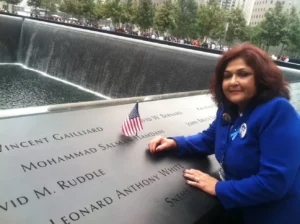
A few years ago, I learned about a twenty-three-year-old named, Mohammad Salman Hamdani. He had graduated from Queens College and was working at Rockefeller University. He was a trained EMT who wanted to attend medical school. He loved Star Wars. He was Muslim. He wanted to help people. And like so many others who rushed to the World Trade Center, he never made it home.
While Mohammad was missing, speculation appeared in the media that he might have been involved in the attacks and that’s why no one could find him. His remains were recovered at Ground Zero months later, in 2002. His family hadn’t only lost him, they had to watch as his name was smeared by public suspicion and Islamophobia that his daily life, nor his sacrifice, justified. All while watching other grieving families being handled with tender hands America decided long ago that most of us are not worthy of. He didn’t die outside the American loss, he died beside and inside it. Then American hatred placed itself on top of his family’s loss, trying to take his life a second time.
I can hardly stomach what’s being asked of a family in that situation. Having to grieve the loss of someone they love while answering for an imaginary villain he never was. Inside the public question of where he is, another question was inserted: what sort of person should we assume this Brown Muslim man was?
There’s a way of telling Mohammad’s story that ends with America realizing his heroism and considers the matter corrected. I get the impulse. But I also worry that it isn’t honest enough about the America he tried to help. His life and his family’s experience should be the drapery for which we understand the division between acceptable Americans who suffered on September 11th and Muslims who suffered on and afterward.
Four days after the attacks, Balbir Singh Sodhi was planting flowers outside his gas station in Mesa, Arizona, when a man seeking retribution for September 11th shot and killed him. Sodhi was Sikh. I remember my grandmother talking about his death. She kept returning to the fact that he was planting flowers. I’m unsure why, but I tell myself this sat with her because planting something outdoors is an act of giving something back to the land. Giving something back to America.
The Islamophobic aftermath wasn’t limited to individual people whose hatred became violence. In 2012, the Associated Press reported that the NYPD’s Demographics Unit had spent more than six years monitoring Muslim neighborhoods without generating a lead or triggering a terrorism investigation, according to the department’s own court testimony. The broader surveillance program collected information about where Muslims lived, worked, shopped, and prayed.
All of this makes it worth asking what never forgetting means for someone whose memories include both the attack and the experience of being dehumanized afterward. September 11th wasn’t just a day, it’s a generation. Are these communities supposed to remember only the portion of September 11th that makes the country comfortable? May they bring the rest of their lives to the anniversary, or will that be considered an inappropriate complication of the occasion?
As the twenty-fifth anniversary approaches, the effort to exclude Mayor Zohran Mamdani from New York’s remembrance ceremony has made that question painfully current. Disgraced former mayor Rudy Giuliani has urged him to stay away and has linked Mamdani’s Muslim faith to the ideology of the September 11 attackers. Mamdani has said he intends to attend to honor the victims, their families, and first responders.
The demand beneath the explicitly anti-Muslim argument is that Mamdani enter the ceremony not as a New Yorker, or an elected official, or even an individual, but as a representative of people who committed a crime. His own relationship to the city becomes secondary to a relationship assigned to him. He is asked to answer for the attackers before he is allowed to stand with the mourners. This is the racial and religious hierarchy I’m talking about when I talk about this country’s sins. Not the proposition that every white person mourning September 11 is acting out some hidden racial agenda, or that a white mother’s grief should be less real. I mean the claim that white people are this country’s default human being, the person whose sorrow requires no explanation, while someone else’s name, skin, ancestry, or religion can be introduced as a reason to doubt the legitimacy of theirs.
September 11th was an atrocity committed by particular people. The American wars throughout the Middle East that followed involved decisions made by other particular people, decisions with their own justifications, alternatives, consequences, and responsibilities. The 9/11 Commission reported that it had found no evidence that Iraq cooperated with al-Qaeda in developing or carrying out attacks against the United States. Yet, America decimated Iraq in the name of September 11th, and so remembering that day honestly requires remembering that information, too.
The families in New York don’t have to be diminished to make the families in the Middle East and elsewhere visible. Nor should Afghans and Iraqis appear only as a pile of injured bodies in American bloodlust.
On August 29, 2021, an American drone strike in Kabul killed aid worker Zemari Ahmadi and nine other people, including seven children. Ahmadi had worked for Nutrition & Education International, a California-based nonprofit, for fifteen years. Reporting established that activity initially regarded with suspicion included loading water into his car. The U.S. military subsequently acknowledged that the strike was a mistake and that the people it killed were civilians.
Among the dead were Ahmadi’s sons Zamir, 20,, Faisal, 16, and Farzad, 10.
I know very little about his sons. I can’t tell you what made them laugh. I can’t say what they found boring, or what they were aspiring to. I’d like to know more about them than that a missile fired by my country killed them. But I know no more about them, than someone in a country across the world knows about the individuals who lost their lives in the World Trade Center.
My citizenship doesn’t make me personally responsible for authorizing that strike no more than Mayor Mamdani’s religion or skin color makes him responsible for September 11th.
On September 8th, Mamdani’s administration released over 150,000 pages of city records concerning the response to the attacks, including air-quality and health concerns, while settling two lawsuits brought by 9/11 Health Watch. The city also announced assistance for people seeking records needed to access federal health and compensation programs.
This shouldn’t be presented as a good deed with which he has purchased admission to the memorial. His belonging wasn’t contingent on releasing these records. But the contrast is worth considering: while people argue about whether he may appear at a ceremony because he is a Brown Muslim man, there’s actual work being done for people whose lives are still being shaped by the attacks.
It’s truly a shame that these people can’t recognize their Muslim mayor’s mutual heartbreak while disagreeing with him about America. No one owns the mourning. What we have, instead, are people to remember and people still here. I keep returning to Mohammad Salman Hamdani and to the future contained in wanting to become a doctor. There was a person there before there was a controversy, someone who expected to have more time.
I won’t end by telling you what he would have wanted from this country. I didn’t know him, and the dead have already been made to endorse too many things they were not here to consider. What I can say is that his life didn’t become valuable when the suspicion was disproved. He didn’t become American when his courage was recognized. And his family’s loss was not waiting for the rest of us to decide what to call him before they knew the word was hero.
If this anniversary is honestly about never forgetting, that means no group has a monopoly on mourning those who didn’t make it home.